Basil is the Co-Founder and CTO of Simple Bundles, where he leads product strategy and development. With deep experience building scalable systems for merchants, he specializes in the technical and operational challenges for back-office operations.
Bundle tutorials
The real economics of free gift offers in ecommerce
The strategy behind profitable free gift bundles, how to structure gwp, bogo offers, and upsell mechanics that actually boost sales.
Basil is the Co-Founder and CTO of Simple Bundles, where he leads product strategy and development. With deep experience building scalable systems for merchants, he specializes in the technical and operational challenges for back-office operations.
You’ve seen it work.
A skincare brand offers a free gift with purchase when customers spend $75+. A coffee roaster runs a buy one get one promotion for subscriptions. A jewelry brand adds a bonus item using a Shopify app that automatically handles auto add to cart logic.
Free gifts convert. Especially when they’re implemented directly in your Shopify store using a free gift offer that feels intentional, not gimmicky. But every time you think about adding one to your bundles, the same question creeps in: how do you do this without killing your average order value (AOV) or margins?
Here’s the thing about free gifts: they’re not really free. Whether you’re using discount codes, automatic discount rules, or bundle pricing, someone is paying for that product.
This post breaks down the strategy behind profitable free gift bundles, how to structure gwp, bogo offers, and upsell mechanics that actually boost sales.
Why "free" beats a discount every time
Behavioral studies show that customers strongly prefer a free product over an equivalent discount. That’s why “Get this item free” outperforms “Save 20%” across product pages, checkout pop-up offers, and even cart upsell widgets.
A study from Dan Ariely's research at Duke found that people dramatically overvalue free items compared to discounted ones. Take, for example, when Amazon introduced free shipping for orders over a certain amount. Sales jumped everywhere except France.
Why? The French promotion charged 1 franc (about 20 cents) for shipping instead of making it free. Same economic impact, completely different psychological response.
This is called the "zero price effect." When something costs $0, it triggers an emotional response that discounts can't match.
For merchants, this means a $10 free item can outperform a $15 price reduction, especially when paired with checkout page messaging or a progress bar that nudges shoppers toward a higher cart value.The perceived value of free dramatically outweighs its actual cost.
At the same time, free gifts only work if customers actually want what you're giving away. A random freebie feels like a clearance dump. A thoughtful gift builds customer loyalty.
How dynamic pricing makes free gifts possible
Standard Shopify bundle pricing gives you one price for the whole bundle. That's fine if every item costs money. But the moment you want to include a free item, you're stuck doing math gymnastics to make the numbers work.
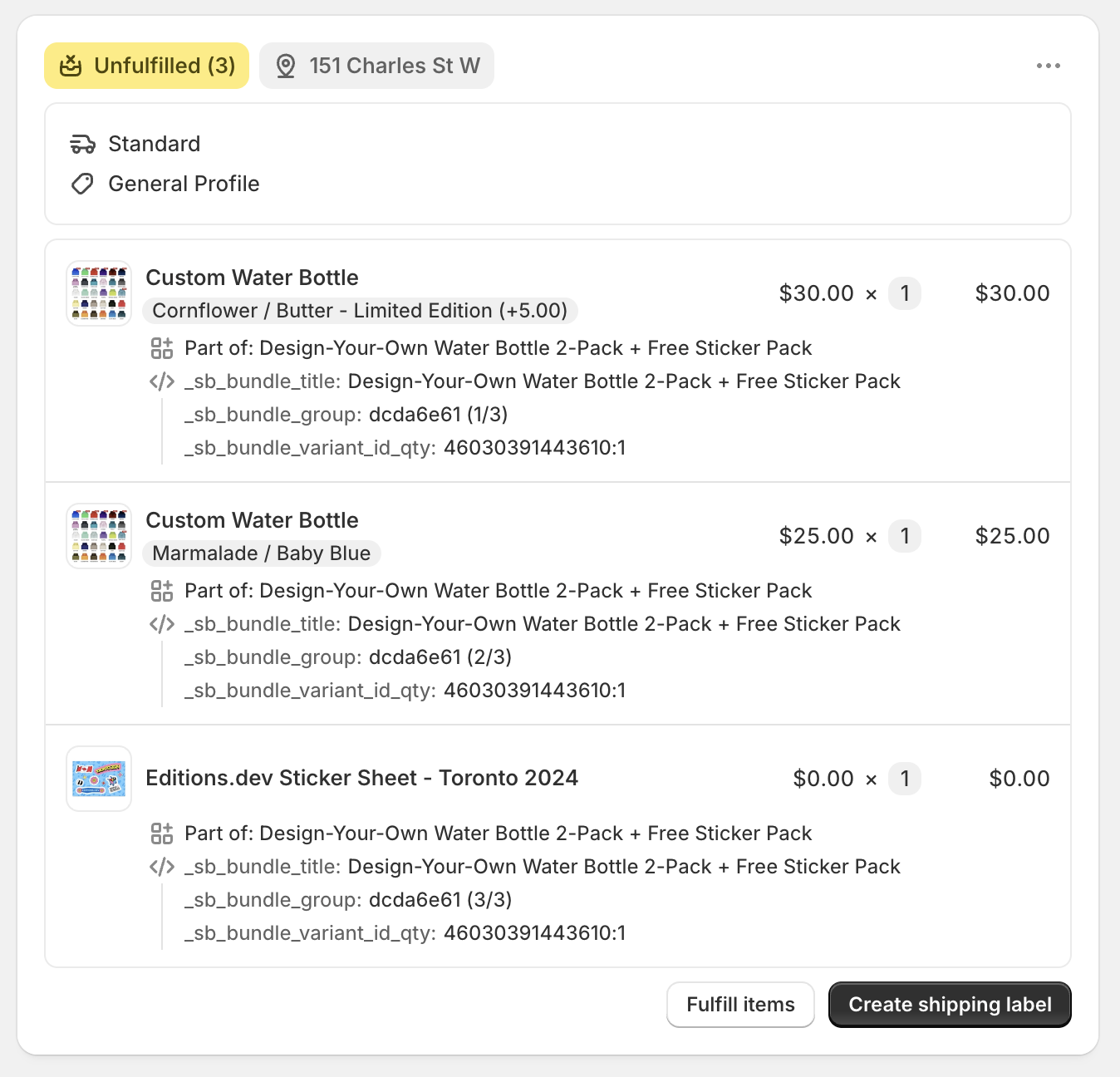
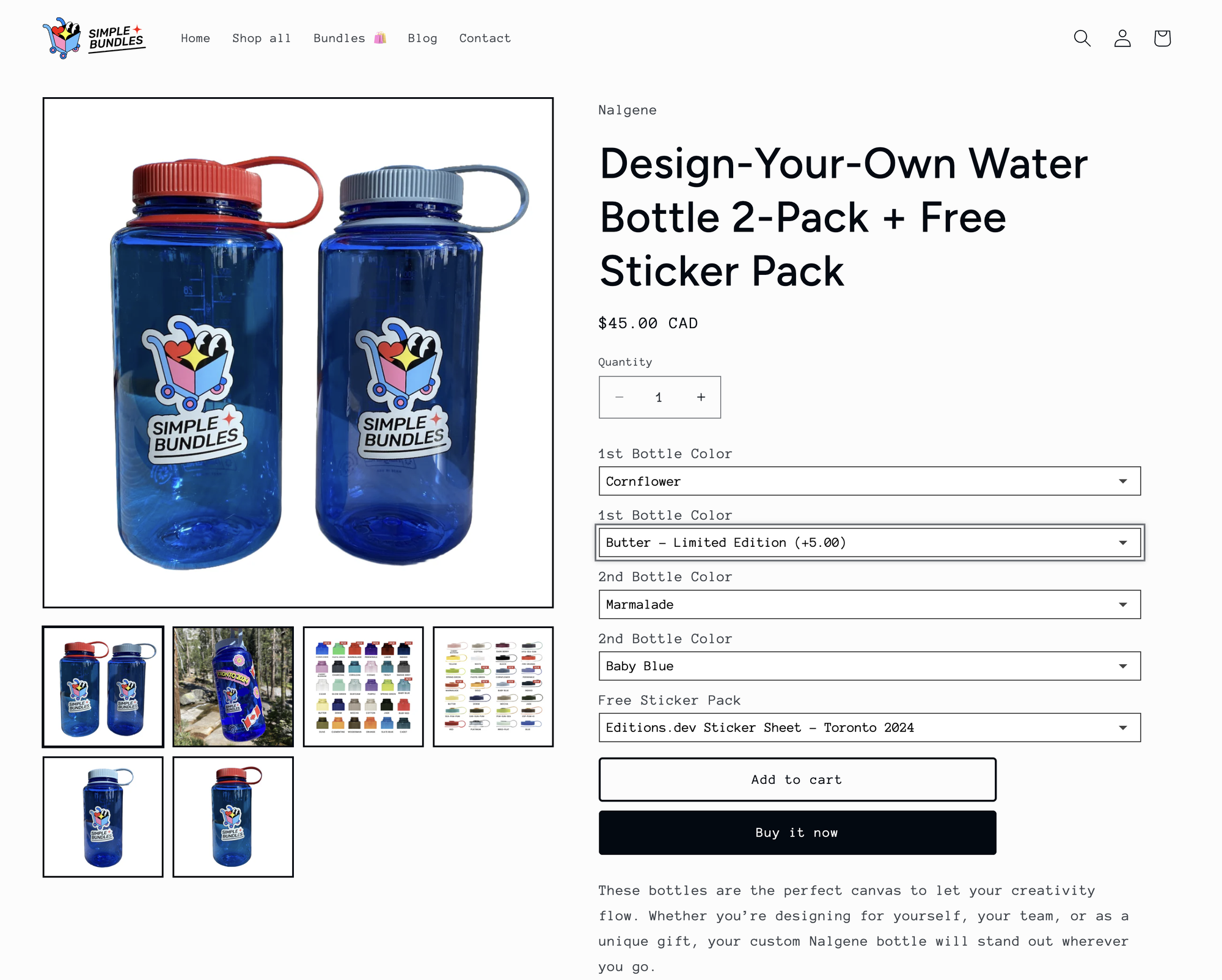
Dynamic pricing in Simple Bundles solves this. Instead of one bundle-wide price, you set individual prices for each item, including setting one item to $0 while keeping everything else at full price (or whatever price you choose).
That means:
You don’t need messy discount codes
You avoid unreliable third-party apps
You can build buy x get y or bogo logic without breaking checkout
This is especially useful for Shopify Plus merchants who want tighter automation, cleaner compatibility, and fewer checkout issues.
The bundle total automatically calculates based on these individual item prices. Customer sees "Free gift included." Your margins stay exactly where you planned them.
Setting up a free gift bundle in Simple Bundles
Here's a step-by-step for how to create a bundle with a free gift item:
In the Products section, click “Adjust item price”
Select the specific product you want to offer as a gift
Set that item’s price to $0
Adjust remaining pricing as needed
Test in your demo store
Save and publish
Here's a video tutorial that may be helpful:
That's it. When customers add the bundle to cart, they'll see the free item at $0 and the total reflecting only the paid items.
One thing to know: When you enable dynamic pricing, all pricing lives in Simple Bundles. If you update prices in Shopify directly, those changes won't sync to your bundles. Make your pricing changes in Simple Bundles to keep everything aligned.
The margin math you need to run first
Before launching any free gift with purchase app or promotion, you need to understand your numbers. Here's a simple framework:
Step 1: Calculate the true cost of your free gift
Your actual cost, not the retail price: product cost, packaging, any additional shipping weight.
Let's say you're a skincare brand. Your travel-size serum retails for $18, but it costs you $4 to produce and package.
Step 2: Calculate your average bundle margin before the free gift
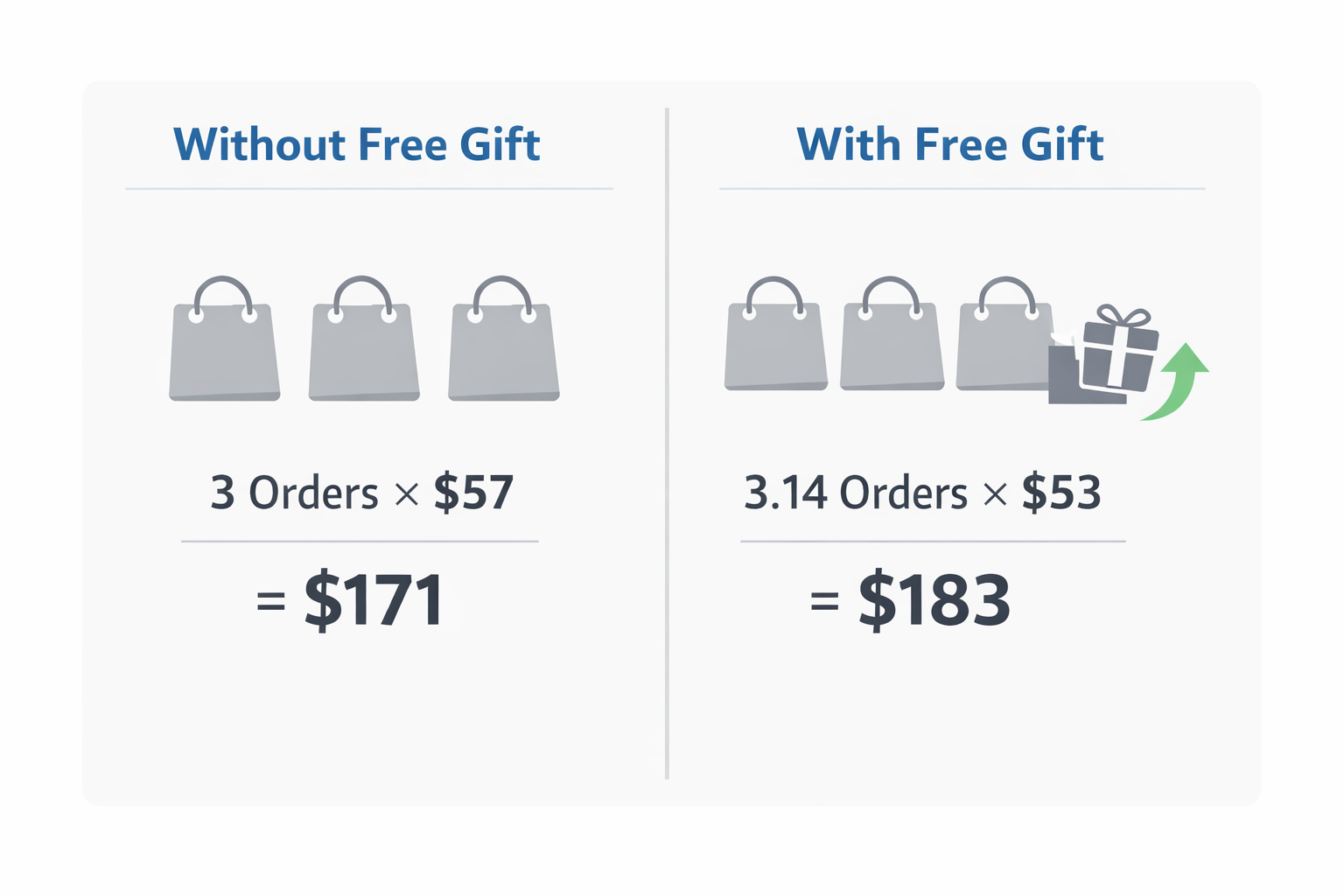
If your bundle sells for $85 and your total product cost is $28, your margin is $57.
Step 3: Subtract the free gift cost from your margin
$57 margin minus $4 free gift cost = $53 actual margin.
Step 4: Determine if the conversion lift justifies the cost
This is where it gets interesting. If adding a free gift increases your bundle conversion rate by 15%, does that extra volume offset the $4 per-order hit?
In this example, the free gift wins. But the numbers will be different for every business.
Three free gift strategies that actually work
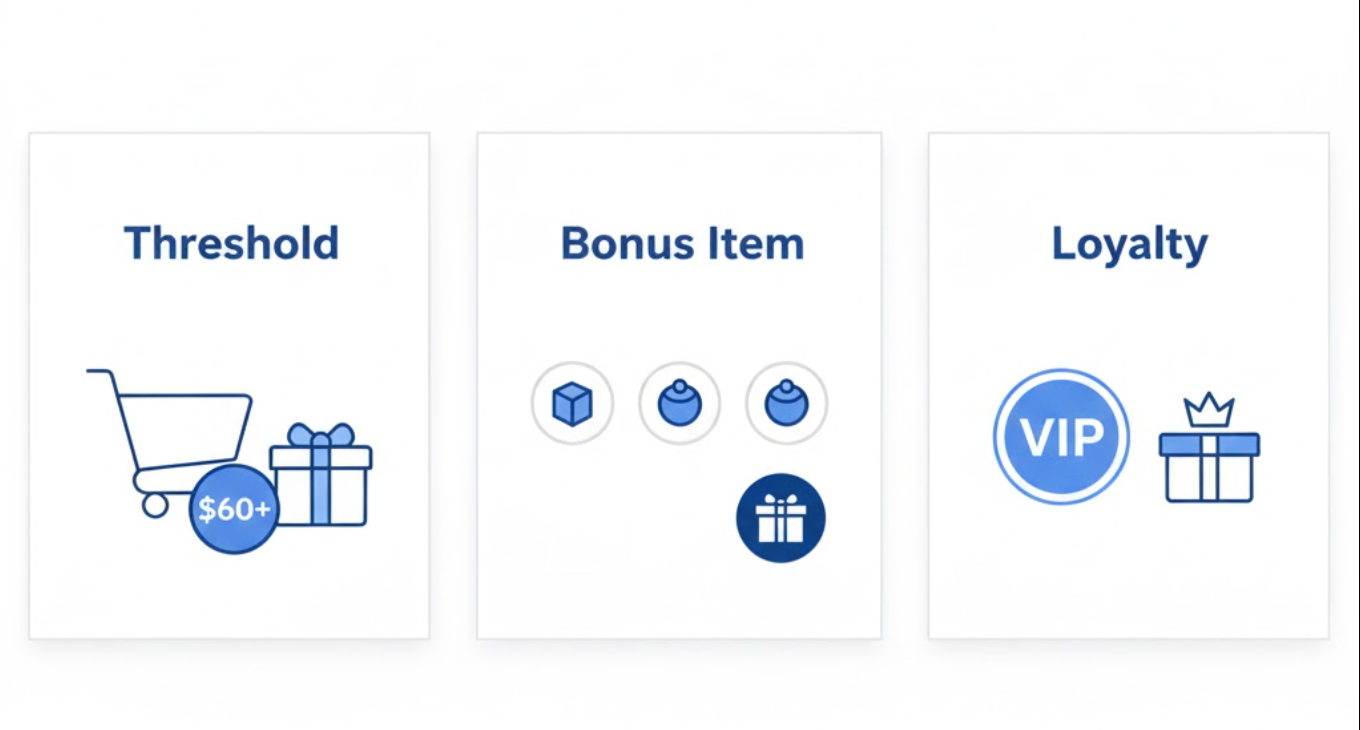
Not all free gift offers are created equal. Here are three structures that consistently perform well:
1. Gift with purchase threshold
How it works: Customer gets a free item when their bundle total exceeds a certain amount.
Example: A coffee brand offers a free bag of their new seasonal roast when customers build a bundle of $60 or more.
Why it works: This strategy increases average order value. Customers who were planning to spend $45 will add another item to hit the threshold. You're not giving away margin. You're trading a low-cost gift for a higher basket size.
Best for: Brands with products at multiple price points where customers might otherwise buy less.
2. Build-your-own with bonus item
How it works: Customer selects X items and automatically gets Y item free.
Example: A jewelry brand lets customers pick any 3 pairs of earrings and includes a free jewelry pouch.
Why it works: The free item feels like a genuine bonus rather than inventory you're trying to clear. It also creates a complete "set" feeling that increases perceived value.
How it works: Free gift is tied to customer status or purchase history, surfaced through a special bundle.
Example: A beverage brand offers VIP customers a bundle that includes a free limited-edition flavor only available to repeat purchasers.
Why it works: The exclusivity creates demand. Customers feel rewarded for their loyalty, which increases retention. And because it's limited to high-value customers, you're investing in relationships that already generate revenue.
Best for: Brands with repeat purchase cycles who want to reduce churn.
Mistakes that quietly eat your margins
Free gifts seem simple. That's what makes them dangerous. Here are the most common ways merchants lose money:
Choosing high-cost gifts for low-value orders. A $6 gift on a $40 order is a 15% margin hit. That same gift on a $120 order is only 5%. Match your gift cost to your order value threshold.
Not tracking the incremental conversion lift. If you can't measure whether free gifts actually improve conversion, you can't know if they're profitable. Run A/B tests. Compare bundle performance with and without the free gift offer.
Using free gifts as a crutch for weak bundles. If your bundle only sells when you add a free gift, the bundle itself probably isn't compelling enough. Fix the core offer first.
Forgetting about fulfillment complexity. Every free gift is another pick, another pack, another potential error. If your fulfillment team isn't prepared, you're trading marketing gains for operational headaches.
Making the gift feel like clearance. Customers can tell when they're being handed something you couldn't sell otherwise. Free gifts should be desirable items, not warehouse overflow.
How to get started with free gift with purchase
Start small. Pick one bundle, one free gift, one clear threshold. Track conversion rate and margin per order for 30 days. If the numbers work, expand. If they don't, adjust your gift cost or threshold until they do.
The merchants who run profitable free gift campaigns aren't more generous. They're more precise. They know exactly what that free gift costs, what lift it creates, and whether the trade is worth making.
Learn how to choose between a discount app and a bundling app based on what you're trying to build. Plus, see how bundle pricing can work alongside Shopify discount codes, how to avoid accidental double-discounting, and why fulfillment should be part of the decision.
Learn why bundle analytics are harder to track than regular product analytics in Shopify and the key metrics brands should monitor. Discover practical ways to track performance through SKU-matching exports, built-in bundle analytics, AI-assisted analysis, Bundle Magic, and promo code attribution.
Stocky shuts down permanently on August 31, 2026. If you sell perishables, track batches or lots, manage expiry dates, or sell multi-SKU bundles, there are real gaps you need to plan around before the deadline.